Spending Discipline on Adult AI Subscriptions
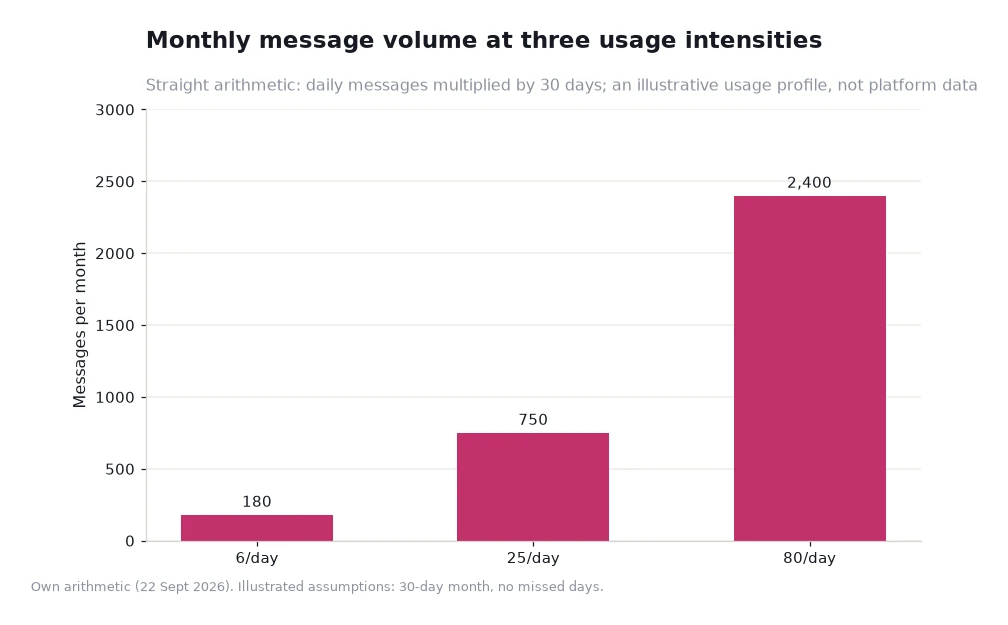
Discipline on an adults-only platform is not about avoiding an upgrade; it is about deciding on evidence rather than in the middle of a session. Crushon publishes its own plan pages, and this article quotes no figures from them — instead it measures the thing you control, which is usage. A month at 25 messages a day is 750 messages; at 80 a day it is 2,400. Those two numbers describe very different habits, and only one of them tends to justify a review of what you are paying for.

Key takeaways
- Measure usage for a full month before judging value: 6 messages a day is 180, 25 a day is 750, 80 a day is 2,400.
- Set a written threshold in advance — a message count or a minutes figure — so the decision is made before a good session can influence it.
- Review on a fixed date, once a month, and change at most one thing each time.
- The platform's own plan and policy pages carry the specifics; nothing on this page quotes a figure from them.
Measure the habit before you judge the value
The first month of using a character platform is a poor basis for any financial decision, because the pattern has not settled. Week one is browsing, week three is where memory starts to matter, and only by week four does the session count stabilise. Judging value in week one is like judging a gym membership after one visit.
The measurement is simple. Count messages for a month, or estimate from sessions: if a typical session runs to twenty-five messages and you average five sessions a week, the month is about 500 messages. Compare that with the three bands above and you have a factual picture of the habit, which is the prerequisite for any decision about what to pay for.
The second prerequisite is a threshold written down in advance. Decide the usage level at which you would review your options — say, two consecutive months above 900 messages, or a weekly minutes figure from your own ledger. Written down beforehand, the threshold is a rule. Invented during a session, it is a rationalisation, and the difference between those two is the entire subject of this article.
Guardrails that survive a busy month
Four guardrails do most of the work. Each one is small, and each one exists to remove a decision from the moment when you are least objective about it.
| Guardrail | How to set it | Failure it prevents |
|---|---|---|
| A fixed review date | One calendar entry a month, on a weekday, outside a session | Reviewing a plan while enthusiastic about a character |
| A written threshold | A message count or weekly minutes figure recorded before the review | Moving the goalposts to justify a decision already made |
| One change per review | At most one adjustment each month, recorded with its date | Bundled changes that make it impossible to tell what helped |
| A 30-day wait | Any decision made mid-session waits a month before it is acted on | Impulse decisions that a single good evening can trigger |
| A written note | Two lines: what you used, what you decided | Repeat reviews that relitigate the same question from memory |
The 30-day wait is the guardrail people resist and the one that earns its place fastest. Nothing about a paid option is urgent, and a decision that still looks sensible a month later was probably never an impulse in the first place.
Worked example: turning a month of usage into a decision
Run the arithmetic on three habits and see how differently they read. At 6 messages a day, the month holds 6 × 30 = 180 messages. At 25 a day it holds 750. At 80 a day it holds 2,400. Now attach a time cost using a one-minute-per-message assumption: 180 minutes, 750 minutes and 2,400 minutes respectively, which is three hours, about twelve and a half hours, and roughly forty hours a month.
Read the three lines as questions rather than conclusions. The first habit, at three hours a month, rarely justifies reviewing anything: the usage is light, and the review would be about curiosity rather than need. The second, at twelve and a half hours, is the interesting band, because that is where a monthly review starts to produce useful information about how you actually use the platform. The third, at forty hours, is a serious commitment of time, and a habit that size deserves a written threshold simply so the decision is not remade from scratch every month.
The volumes, the time conversion and the 30-day assumption are the author's illustrative arithmetic rather than platform data, and no figures from the platform's own plan pages are quoted anywhere in this article. The point is the method: measure, threshold, review on a date.
Where the actual details live
Everything specific about a Porn Chat AI plan belongs on the platform's own pages, not in an article like this one. The plan details sit behind the unlimited plan page, and the policy pages cover what the service does and does not include. Read those directly when your threshold says it is time; this page exists to make sure that reading happens at a rational moment rather than an emotional one.
There is also a wider context worth keeping in mind while deciding. Some of what people expect to pay for is better solved by habits: a longer session with a stated premise, a shortlist drawn from descriptions rather than ranks, and the memory layer doing its work. Those cost nothing and are the reason many readers who arrive searching for ai porn chat experiences end up using the platform more, not less, without changing anything about what they pay.
One last habit: never make the decision in the same hour as a session. Finish, close the tab, and let the threshold rule. A decision that survives a day without a chat is a decision about the platform; one that does not is a decision about the evening.
Frequently asked questions
How do I work out what my usage actually is?
Count messages for a full month, or estimate from sessions and average length. Five sessions a week at twenty-five messages each is roughly 500 messages a month, which is enough precision for a decision.
Should the review happen monthly or quarterly?
Monthly while the habit is still settling, then quarterly once two consecutive reviews produce the same answer. The cadence should follow how much the pattern is actually changing.
What if my usage is well below the threshold?
Then the review takes thirty seconds and produces no change, which is a good result. A review that usually ends in "no change" is doing its job.
Where should I look for the plan details themselves?
On the platform's own pages, every time. This article deliberately quotes no figures from them, because plan details change and a stale summary is worse than none.
Decide on a date, not in the moment
Set a calendar entry for the same weekday next month, write your threshold beneath it, and record two lines afterwards: what you used, what you decided.
Do that three times and the question stops being intimidating, because you will be answering it with your own data instead of someone else's persuasion.
Data and sources: platform plan and policy pages as published by Crushon.AI, read 22 Sept 2026[1]. No pricing figures are quoted. Message volumes and the time conversion are illustrative arithmetic by the author and are not platform data. This article is for adults aged 18 and over.