What Materials Are Best for custom hydraulic hoses?
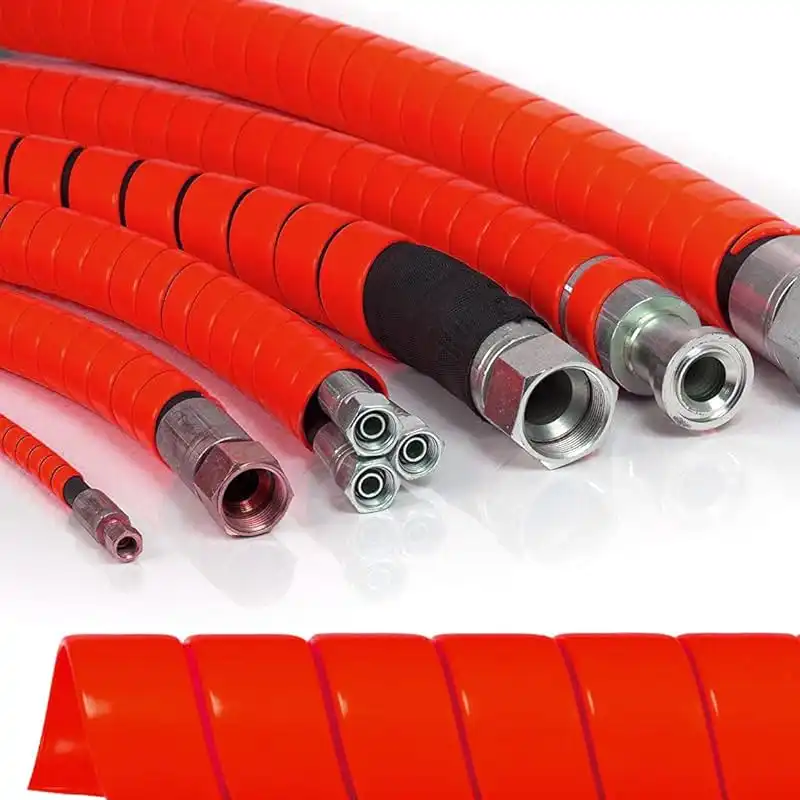
For most hydraulic equipment using petroleum-based oil, nitrile rubber is the preferred tube material, high-tensile steel wire supplies pressure reinforcement, and abrasion-resistant synthetic rubber protects the outside. A 3/4-inch SAE 100R15 hose can be rated around 6,000 psi, while some specialized hydraulic hoses reach 8,000 psi. Parker lists -40°F to 257°F (-40°C to 125°C) for several heavy-duty designs. PTFE becomes more suitable when chemical resistance or elevated temperature matters, while textile and aramid reinforcement reduce weight. Material selection must match fluid, pressure, temperature, bend radius, fittings, and external exposure rather than pressure alone.
A hydraulic hose is normally built from three working material groups: the tube touches the fluid, reinforcement contains internal pressure, and the cover protects the reinforcement from abrasion, moisture, ozone, and oil. SAE J517, revised in 2020, covers dimensional and performance requirements for common hydraulic hoses used on mobile and stationary machinery. It also states that the allowable working pressure of a hose assembly cannot exceed the lower rating of the hose or its connector.
That layered construction explains why custom hydraulic hoses cannot be selected by asking for a single “best rubber.” A nitrile tube may have excellent compatibility with mineral hydraulic oil, yet the assembly can still have a short service life if its wire reinforcement is undersized, the cover wears through, or the fitting is not approved for the hose construction.
Nitrile rubber, usually called NBR, remains one of the most common tube materials for petroleum-based hydraulic fluids. Parker's 792TC SAE 100R15 hose, for example, uses a nitrile inner tube, four or six spiral-steel reinforcement layers, and an abrasion-resistant synthetic-rubber cover. The 3/4-inch and 1-inch versions are both listed at 6,000 psi working pressure and operate from -40°F to 257°F.
NBR works well because its acrylonitrile component improves resistance to petroleum oils, fuels, and many lubricants. Different NBR compounds do not perform identically: raising acrylonitrile content generally improves oil resistance while reducing flexibility at very low temperature. A hose maker therefore adjusts the compound rather than treating every nitrile tube as interchangeable.
A tube can be chemically compatible with the fluid and still be unsuitable for the operating temperature, pressure cycling, or routing of the machine.
Once tube compatibility is established, reinforcement becomes the next material choice. Braided high-tensile steel wire is widely used for medium- and high-pressure service because wire carries circumferential stress far better than the elastomer alone. Two-wire braid offers more pressure capacity than a single braid while remaining flexible enough for many excavators, tractors, presses, forklifts, and industrial power units.
Spiral reinforcement is used when pressure and repeated pressure cycles become more severe. Parker's 792TC/792ST construction uses four or six spiral wires and carries 6,000 psi, while its six-spiral 761 hose is listed at 8,000 psi in 3/4-inch and 1-inch sizes. The 1-inch 761 has a 13-inch minimum bend radius and weighs about 2.02 lb/ft, showing the trade-off between high pressure capacity, mass, and routing space.
| Material | Common Position | Practical Strength | Typical Limitation |
|---|---|---|---|
| NBR | Inner tube | Petroleum-oil resistance, flexibility, moderate cost | Poor choice for several phosphate-ester and strongly oxidizing fluids |
| EPDM | Tube or cover | Water, ozone, weather, many water-based fluids | Generally unsuitable for petroleum oil |
| PTFE | Inner tube | Broad chemical resistance and high-temperature capability | Less elastic; bend behavior differs from rubber |
| Steel wire | Reinforcement | High pressure capacity and strong fatigue performance | Higher weight and electrical conductivity |
| Polyester textile | Reinforcement | Low weight and flexibility | Lower pressure capability than many wire designs |
| Aramid fiber | Reinforcement | High tensile strength with low mass | More expensive and construction-specific |
| Synthetic rubber | Outer cover | Abrasion and weather protection | Performance depends on compound |
| Stainless steel | Braid or fittings | Corrosion and heat resistance | Higher material cost |
Textile reinforcement becomes useful when maximum pressure is lower and low weight matters more. Polyester or similar high-strength fibers can support hydraulic and pneumatic applications without the mass of steel. Aramid goes further: its tensile strength-to-weight performance allows manufacturers to design compact thermoplastic hoses for equipment where repeated movement, smaller routing spaces, or weight reduction matters.
The pressure rating still has to come from the finished hose assembly, not from the theoretical strength of the fiber. SAE J517 has been used for hydraulic hose specifications since its original 1952 issue and has undergone repeated revisions as hose constructions changed. Several older 100R categories, including 100R9, 100R10, and 100R11, were later discontinued, showing why an old hose designation should not be copied without checking the present specification.
Thermoplastic hose uses polymers such as polyamide or polyester-based materials instead of a conventional rubber tube and cover. Its smaller outside diameter and lower weight can help on aerial equipment, compact machinery, lubrication systems, test equipment, and hydraulic circuits containing long hose runs. Smooth thermoplastic bores can also reduce internal surface roughness compared with some rubber constructions.
Temperature places a firm boundary around polymer choice. A hose rated for 125°C fluid should not be assumed suitable beside an exhaust component producing much higher radiant temperature. Gates advises that neither the conveyed-fluid temperature nor the external hose temperature should exceed the manufacturer's stated maximum, while very low temperatures may require a construction specifically designed to retain flexibility.
PTFE moves into consideration when conventional elastomers have insufficient chemical or temperature resistance. Virgin PTFE has unusually broad chemical compatibility and Parker describes typical material service capability approaching ±500°F under suitable conditions, although actual allowable temperature depends on pressure, movement, fillers, and the finished component design. PTFE hose ratings must therefore come from the hose specification rather than the polymer's raw-material temperature figure.
PTFE tubes are commonly paired with stainless-steel braid because the fluoropolymer itself does not provide the pressure containment required by many hydraulic systems. Smooth-bore PTFE favors unrestricted flow and easier cleaning, while convoluted versions improve flexibility. Stainless braid also offers better corrosion resistance than exposed carbon-steel wire when equipment works around salt water, aggressive cleaning chemicals, or corrosive industrial environments.
Chemical compatibility must cover the tube, fitting, seal, plating, cover, and any cleaning fluid that can contact the assembly.
EPDM occupies a different chemical range. It performs well with water, many water-based solutions, ozone, and outdoor weather exposure, but petroleum oil causes problems for most EPDM formulations. Installing EPDM merely because its temperature resistance looks suitable can therefore be a poor choice in a mineral-oil circuit. NBR and EPDM may look similar from the outside while reacting very differently after prolonged fluid contact.
Fitting material narrows the choice further. Carbon steel is common because it offers high mechanical strength at moderate cost, usually with a protective surface treatment. Stainless steel is preferred where corrosion resistance or fluid compatibility warrants the added cost. Brass appears in selected lower-pressure or corrosion-sensitive applications, but its allowable pressure and fitting design must match the hose.
SAE J517 explicitly limits an assembly to the lower working-pressure rating of its components. A 6,000 psi hose fitted to a connector approved for only 5,000 psi therefore remains a 5,000 psi assembly, not a 6,000 psi assembly. That 16.7% difference is large enough to matter when specifying replacement hoses for equipment with pressure spikes.
Cover material deserves equal attention because many field failures begin with external wear rather than fluid attack. Synthetic-rubber covers are widely used because appropriate compounds resist abrasion, weather, ozone, and occasional oil contact. Thermoplastic covers can offer particularly good abrasion resistance and are often used where hoses rub against guards, cable carriers, or neighboring hose lines.
Cover damage exposes steel reinforcement to moisture and corrosion. Routing therefore matters alongside material choice: a more abrasion-resistant cover cannot compensate for a hose continuously scraping against a sharp steel edge. A 1-inch spiral hose may require roughly a 13-inch minimum bend radius in one heavy-duty design; forcing it through a 7-inch bend creates far more strain than the hose was designed to accept. Parker publishes 330 mm, approximately 13 inches, for several 1-inch high-pressure constructions.
Electrical service adds another material requirement. Most wire-reinforced hydraulic hoses conduct electricity because their reinforcement contains steel. Gates specifically advises using rated non-conductive hose around electrical lines and notes that hydraulic fluids themselves can also conduct electricity. Fiber-reinforced thermoplastic constructions are often considered for such equipment, but nonmetallic reinforcement alone does not establish an electrical safety rating.
Pressure, temperature, fluid, routing, and environment should therefore be specified together. A petroleum-oil excavator working at 5,000–6,000 psi may favor NBR, multi-spiral steel reinforcement, and an abrasion-resistant synthetic-rubber cover. A chemically aggressive process line may favor PTFE with stainless braid. A compact moving system operating at moderate pressure may benefit more from thermoplastic construction with textile or aramid reinforcement.
Cost differences should be compared against the entire assembly rather than material price per foot. Four- or six-wire spiral hose weighs more, requires larger routing space, and often uses heavier fittings; fiber-reinforced thermoplastic hose can reduce mass but may require different couplings and crimp specifications. Parker's published examples range from about 1.07 lb/ft for a 3/4-inch 6,000 psi 792TC/ST hose to 1.56 lb/ft for a 3/4-inch 8,000 psi 761 hose, an increase of roughly 46% in hose weight per foot.
Material selection is therefore best completed from actual operating numbers: exact fluid name, continuous pressure, expected pressure peaks, minimum and maximum fluid temperature, ambient temperature, inside diameter, required bend radius, motion frequency, abrasion exposure, fitting type, and applicable SAE or ISO specification. Selecting from those numbers gives NBR, EPDM, PTFE, thermoplastic, steel wire, textile, aramid, carbon steel, or stainless steel a defined engineering role instead of treating one material as suitable for every hydraulic system.